Your sales team doesn't need another AI tool. They need an AI co-worker.
The sales AI industry has spent the last three years building smarter dashboards. It's time for something fundamentally different.

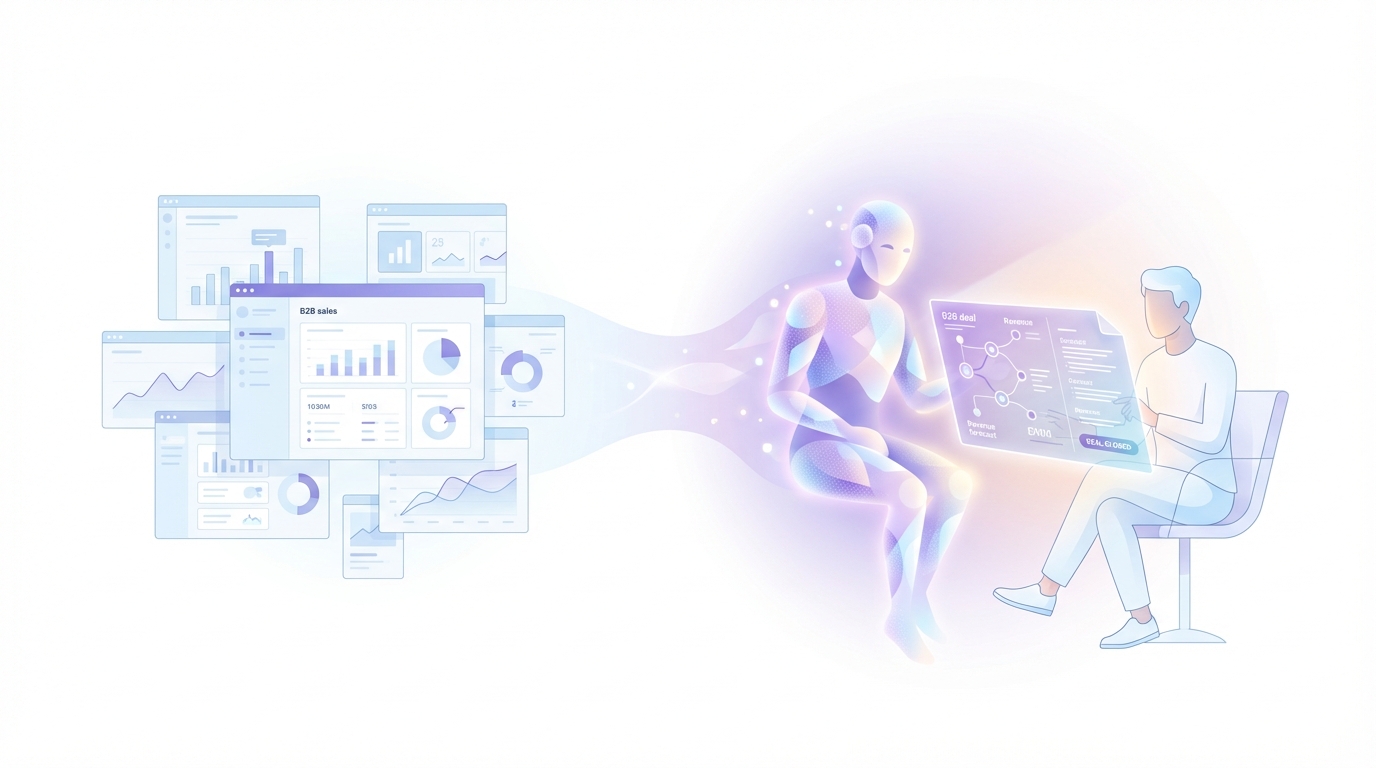
The average B2B sales team now uses 10+ tools in their daily workflow. CRM, conversation intelligence, sequencing, forecasting, enablement, coaching. The stack keeps growing. And in the last two years, nearly every one of those tools has added "AI" to their feature list.
So here's the question worth asking: if sales teams have never had more AI at their fingertips, why are win rates still declining?
The answer isn't that the AI is bad. It's that we've been building the wrong thing.
The problem with generic AI in sales
Most AI in sales today falls into one of two buckets.
The first is AI-as-analyst: tools that listen to your calls, analyze your pipeline, and surface insights. "Your deal is at risk." "Your competitor was mentioned." "Your champion hasn't engaged in 8 days." This is useful. But it's still just information. The rep has to figure out what to do about it, and then actually do it.
The second is AI-as-chatbot: generic copilots that can answer questions or draft content when prompted. "Write me a follow-up email." "Summarize this call." "What should I do next?" These help when you know exactly what to ask. But they start from zero every time. No memory of your deals, your buyers, your company's value proposition, or how you like to work.
Both approaches share the same fundamental limitation: they wait for you to do the work. One tells you what's happening. The other helps when you ask. Neither actually picks up a task and runs with it.
Meanwhile, every rep on your team has the same 24 hours, and they're spending more than half of it on non-selling activities: updating CRM, building business cases, writing follow-ups, prepping for meetings, chasing next steps. The AI tools in their stack might save them twenty minutes of analysis. The rest of the grind remains untouched.
What a co-worker does differently
Think about the best colleague you've ever worked with. Not a manager. Not a tool. A peer who just got things done alongside you.
That person didn't wait for you to ask them for a status update. They proactively flagged when something needed your attention. They didn't just tell you a deal was at risk. They drafted the recovery email and had talking points ready for your next call. They remembered how you like to work. They learned your style over time. They delivered what you needed, where you needed it, often before you even knew you needed it.
That's the difference between a tool and a co-worker. And it's a much larger gap than most people realize.
A tool responds when prompted. A co-worker takes initiative. A tool suggests what you should do. A co-worker does the work. A tool delivers output when you retrieve it. A co-worker puts it where you already are: in your inbox, your Slack, your CRM. A tool operates one task at a time. A co-worker understands your entire book of business and makes decisions about where your time is best spent.
Most critically: a tool requires you to configure it. A co-worker adapts when you tell them to do something differently. If your AI generates mutual action plans too early in your deals and you say "wait until we've confirmed budget," a tool makes you go find a settings page and adjust a threshold. A co-worker simply says "Got it, I'll adjust." And does.
Why this distinction matters now
We're at an inflection point. The first wave of AI in sales was about intelligence: capturing and analyzing data that was previously invisible. Conversation intelligence, revenue intelligence, pipeline analytics. This was genuinely valuable and companies like Gong built billion-dollar businesses on it.
But intelligence without execution creates a paradox: the more insights you surface, the more work you create for reps to act on. You've given them better visibility into their pipeline, and simultaneously added more to their plate.
The more insights you surface, the more work you create for reps to act on.
The enterprise sales model has always followed a costly linear rule: grow revenue, hire more reps. AI-as-analyst doesn't break that equation. It makes each rep slightly more informed, but they still carry the same execution burden. You still need the same headcount.
Breaking that equation requires AI that doesn't just analyze, but executes. AI that generates the business case when the deal is ready for one. That drafts the follow-up email in the rep's voice, with the right proof points, to the right stakeholder. That prepares a meeting brief two hours before a call, without being asked. That looks across all of a rep's deals and says "these three need your attention today, and here's what I've already prepared."
What this looks like in practice
The best way to understand the difference is through a typical morning.
With generic AI tools: You open your CRM. You see a dashboard of deal health scores. Three are flagged red. You click into each one to understand why. You pull up the last call transcript in your conversation intelligence tool. You ask the AI chatbot to summarize key points. You draft a follow-up email manually. You check your calendar and start prepping for your 11am call, pulling together notes from your last meeting. An hour and a half has passed and you haven't talked to a single customer.
With an AI co-worker: You open Slack and your co-worker has already sent you a morning briefing. Three deals need attention. For the highest priority, where your champion went silent after pricing, there's already a re-engagement email drafted in your voice, using a proof point from a similar customer who overcame the same objection. For your 11am call, talking points are ready based on the last conversation, with a note about a new stakeholder who appeared in a recent email thread. You review, approve, and get on with your day. Thirty minutes, and the work is done.
The difference isn't marginal. It's a fundamentally different way of working.
The three requirements for a true AI co-worker
Not every product that claims to be an "AI assistant" or "AI copilot" actually behaves like a co-worker. There are three capabilities that separate the two:
Deep, persistent context. A co-worker doesn't start from scratch every conversation. It knows your deals: who the stakeholders are, where each deal stands, what was discussed in the last call, what blockers exist, what proof points resonate with this buyer's industry. It knows your company: the value proposition, competitive positioning, case studies. And it knows you: your writing style, your preferences, your patterns. This isn't a feature. It's the foundation everything else is built on.
Proactive execution. The co-worker doesn't wait to be prompted. It monitors signals across your deals and creates work products when they're needed: meeting prep before calls, follow-up drafts after meetings, business cases when deals reach the right stage, re-engagement plans when champions go quiet. The defining experience is "I didn't even know I needed this, but here it is."
Adaptive learning. The co-worker gets better over time. It learns which outputs you use and which you ignore. It adjusts when you give feedback. It earns trust, starting cautious, showing you what it would do, and gradually acting more autonomously as it proves its judgment. This isn't about configuring settings. It's about building a working relationship.
The category that doesn't exist yet
The sales technology landscape has well-defined categories: CRM, sales engagement, conversation intelligence, revenue intelligence, sales enablement. Each one has clear leaders and a recognized set of capabilities.
What doesn't have a category yet is the layer that sits on top of all of them. The execution layer. The layer that takes all the data, all the analysis, all the insights, and turns them into completed work. Not recommendations. Not alerts. Actual work product that a rep can review, approve, and use.
This is the gap Optivian exists to fill. Not another tool that tells reps what they should do. An AI co-worker named Ollie that does the work alongside them: building business cases, creating mutual action plans, enabling champions, recommending and executing next-best actions. All grounded in deep understanding of every deal, every stakeholder, and every rep's way of working.
The industry has spent three years using AI to give sales teams better visibility. It's time to give them actual help.
Ready to transform your sales team?
Book a demo to see AI-powered digital labor that turns every seller into your best seller.
Book a demo