From recording to executing: sales AI's next chapter
Sales AI spent a decade analyzing calls. The next era is about execution — AI agents that do the work, from business cases to pipeline management. See how Ollie makes it real.

For a decade, the sales technology industry has been obsessed with one question: what happened on that call?
Billions of dollars have gone into recording, transcribing, and analyzing sales conversations. And to be fair, the results have been impressive. We can now tell you exactly when a prospect mentioned a competitor. We can score rep performance on talk-to-listen ratio. We can surface keywords that correlate with closed-won deals.
But here is the uncomfortable truth: knowing why you are losing does not actually help you win.
The insight-to-action gap
I have spent the past year talking to sales leaders at mid-market and enterprise B2B companies. The pattern is remarkably consistent.
They have dashboards full of data. They can see which deals are at risk, which reps are underperforming, and which stages have the highest drop-off rates. They are not lacking insight. There is no shortage of it.
What they lack is execution capacity. Building a compelling business case for a specific deal. Creating a mutual action plan that keeps both buyer and seller accountable. Enabling an internal champion with materials they can actually use to sell on your behalf when you are not in the room.
This is the work that separates top-performing reps from the rest. And it is the work that most teams simply do not have enough hours in the day to do well.
When I scaled Smarp and Haiilo to over $40M in ARR, the same pattern showed up in every team I managed: a small fraction of salespeople consistently drove the majority of revenue. They had the same CRM, the same playbooks, the same enablement. The gap was not information. It was execution.
The three eras of sales AI
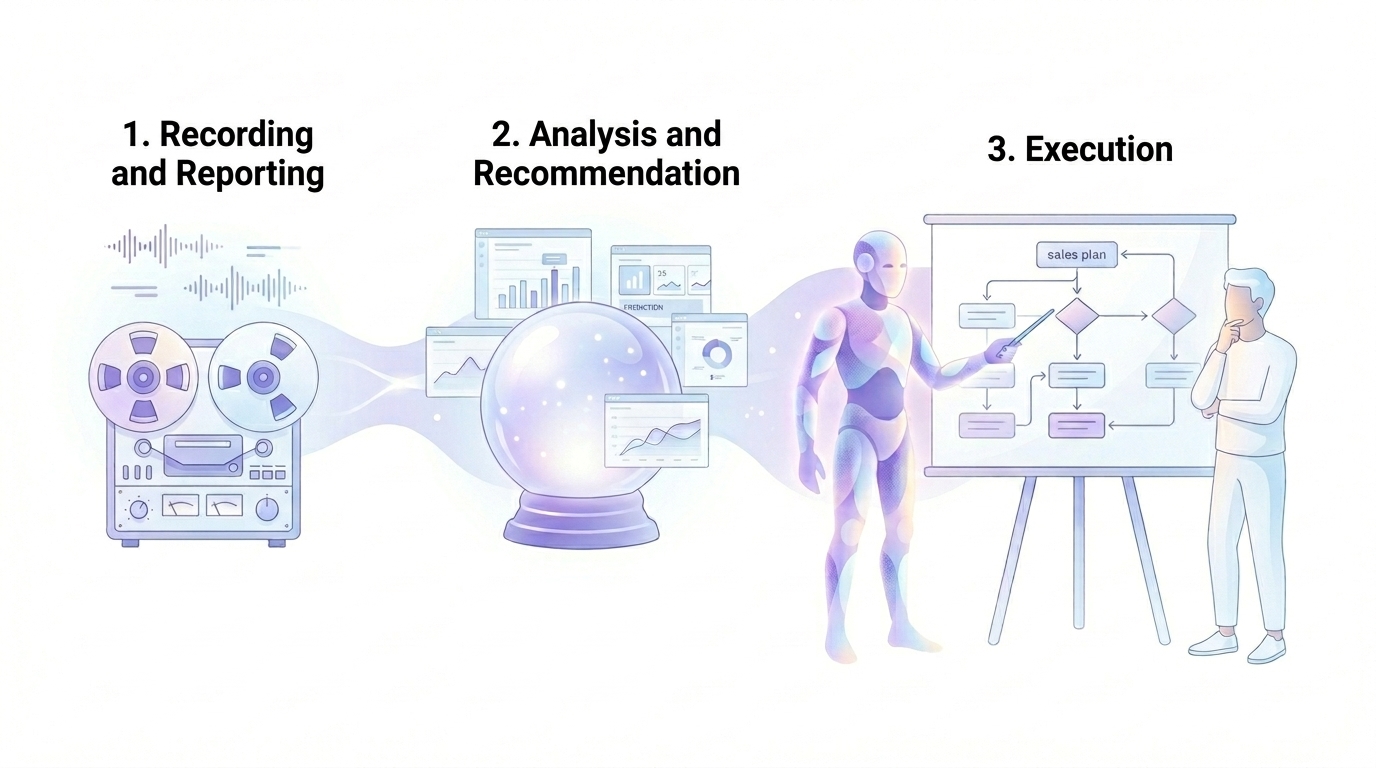
Looking at how AI has evolved in sales, I see three distinct phases.
Recording and reporting
Where most of the market still sits. AI records your calls, transcribes them, and generates summaries. Products like Gong pioneered this space and built a massive category around conversation intelligence. The value is real: you get visibility into what is happening across your pipeline.
Analysis and recommendation
AI does not just tell you what happened, it tells you what it thinks you should do. Revenue intelligence platforms aggregate signals across deals and flag risks. They score opportunities and suggest next steps. The problem is that the recommendation lands on a dashboard, and someone still has to do the work.
Execution
This is what is starting to happen now, and it is where autonomous AI sales agents change the game. AI does not just observe or advise. It acts. It produces the actual work product that moves the deal forward. A business case grounded in real data. A re-engagement sequence triggered the moment a deal goes quiet. A champion enablement document written from the buyer's perspective.
The shift from Era 2 to Era 3 is not incremental. It is a fundamental change in what AI is for.
Why analysis alone was never going to be enough
Most companies that have invested heavily in conversation intelligence and revenue analytics are still operating in Era 1 or Era 2. They have more data than ever, and yet average B2B win rates have barely moved from where they were five years ago.
The reason is structural. Analysis creates a bottleneck at the exact point where it should create leverage.
Here is what I mean. A typical conversation intelligence tool might flag that a deal is at risk because the economic buyer has not been engaged in the last three weeks. Useful signal. But then what? The rep has to open the CRM, review the deal context, draft an email, figure out the right angle, maybe pull together some supporting materials, and send it. That is 30 to 45 minutes of work per deal. Multiply that across a pipeline of 30 to 50 opportunities and you start to see why even the best reps cannot keep up.
The insight created more work. It did not reduce it.
This is the same pattern I see every week when I talk to sales and RevOps leaders. They start with an existing process and ask: "How do we automate this with AI?" That is the wrong starting point.
Take business cases. Almost every company has a template. Almost every team wants AI to fill it out faster. But when I ask whether reps actually use the template as-is, the answer is almost always no. Too rigid. Too generic. Does not fit the customer.
The better question: "How do we build the most compelling business case for this specific deal?" Let AI figure out the best way to do that based on everything it knows about the customer, the competitive landscape, and what has worked in similar deals before.
From tool to co-worker
The language we use matters. When we talk about AI "tools," we unconsciously set the expectation that the human does the work and the tool assists. You go to it. You ask it something. You come back when you need it.
But the next generation of autonomous AI sales agents works differently. They operate more like co-workers than tools.
A co-worker does not wait for you to ask. It sees what needs to happen and takes initiative. It understands the full context of the deals you are working on, not just the last call. It does work on your behalf and delivers the result to where you already are, whether that is Slack, email, Teams, or your CRM.
A tool tells you a deal is at risk. A co-worker drafts the recovery plan, with the right proof points, in your voice, and sends it to your inbox before you even checked the dashboard.
This is the shift that 2026 is making real. The foundation models are no longer the bottleneck. After a year where the industry focused on context engineering, giving AI the right knowledge about your company, your deals, and your industry, we are now at the point where sales AI agents can apply that knowledge proactively. They can monitor your pipeline around the clock, spot patterns a human would miss across 50 deals, and generate work product that is specific to each situation.
What execution actually looks like
To make this concrete, here are a few examples of what AI sales execution means in practice.
A deal has gone quiet
The AI co-worker detects two weeks of silence, analyzes the deal context, and drafts a re-engagement email in the rep's voice — surfacing a relevant industry development or an unfulfilled commitment from the last meeting. It arrives in the rep's Slack, ready to send.
A champion needs consensus
Instead of the rep spending two hours on a slide deck, the AI generates a value summary from the champion's perspective — grounded in case studies and quantified outcomes. The champion walks into the CFO meeting with a document they can present as their own.
A deal reaches negotiation
The AI creates a mutual action plan with specific milestones, dates, and shared ownership between buyer and seller. It bases the timeline on patterns from similar deals that closed successfully. Both sides have a clear path to close.
None of these examples require the rep to open a dashboard, write a prompt, or remember to check on a deal. The work gets done proactively and delivered to where the rep already is.
The proactive sales team
This shift has implications beyond individual deals.
When AI handles the execution layer of sales (the business cases, action plans, coaching insights, re-engagement sequences, and pipeline monitoring) it does not just free up time. It fundamentally changes what a sales team can accomplish.
A rep managing 40 deals can now have each one actively worked, every day, with the right action happening at the right time. A manager can see not just which deals are at risk, but what has already been done about it. RevOps can enforce qualification discipline across the pipeline without adding another data entry step for reps.
The result is that growth no longer requires a linear increase in headcount. The AI co-worker handles the execution gap that has historically limited how many deals a single rep can work effectively.
This is what "AI Sales Execution" means. Not replacing salespeople. Not adding another layer of analytics on top of your existing stack. Instead, building a new execution layer that takes on the 60% of sales work that is not actually selling, the research, the admin, the asset creation, the pipeline monitoring, and handles it at a level of consistency and speed that no human team can match across every deal, every day.
The question every sales leader should ask
If your current sales AI investment is primarily giving you better visibility into what is happening in your pipeline, ask yourself: what is actually being done about it?
The companies that will win the next five years of B2B sales are not the ones with the best dashboards. They are the ones that figured out how to turn AI from an observer into a participant.
The next chapter of sales AI is not about watching more carefully. It is about doing the work.
Ready to see Ollie in action?
Book a demo to see how Ollie executes the work that wins deals.
Book a demo