The hidden cost of connecting AI straight to your sales stack
Most sellers have wired their AI straight into their CRM, meeting recorder, and email. It works. It is also burning through tokens, missing context, and rebuilding the same picture from scratch every single day.

Over the past year, a quiet shift has happened in how sellers actually use AI. The early experiments with copying and pasting call notes into ChatGPT have given way to something more serious. Reps are now connecting their CRM, their meeting recorder, and their email directly to the AI of their choice, whether that is Claude, ChatGPT, or Gemini. On paper this is exactly what you want. The AI has access to everything, so it should be able to answer anything.
In practice, it is far more expensive and far less reliable than people realize. And the reason has nothing to do with the model being used. It has to do with how the work gets done every time you ask a question.
What actually happens when you ask a question
Picture a simple request. You ask your AI, "Where do things stand with the Acme deal?"
Before it can answer, the AI has to do a surprising amount of work. First it has to find the right deal. Then it has to pull every email, every meeting, and every note tied to that deal so it can assemble a complete picture. Here is the catch: it has no idea which email or which meeting actually contains the information that matters for your question. So it does one of two things. It either misses something important, or it pulls in far more than it needs. Either way you lose. Missed context means a wrong answer. Excess context means you are paying for tokens you did not need and crowding the AI's context window with noise that makes the real answer harder to find.
Now fast forward to the next day. You open a fresh chat and ask a different question about the same deal. The AI starts over. The analysis it did yesterday is not saved anywhere it can reach, and even if it were, that analysis was shaped around yesterday's question. The parts that are relevant today were probably left out. So it rebuilds the entire picture from raw material all over again.
It is like assigning a brand new analyst to the deal every single morning, one who has to relearn everything before they can be useful, and who then forgets it all by the next day.
Then multiply it across your pipeline
So far this is the cost of understanding one deal. Now ask a harder question, the kind that actually wins deals: "How did we handle this objection in other similar deals?"
The AI now has to understand not just this deal, but a whole set of others. And it has no idea which of those deals are relevant. So it starts guessing. It scans through interactions hunting for something that looks similar, and every time it finds a candidate it has to rebuild the surrounding context to understand how that moment fit into the larger story. The token cost climbs fast, and the answer quality drops because the model is spending its reasoning budget on retrieval and reconstruction instead of on the actual question.
And all of this is being done by whatever frontier model the rep happens to be using. Those models are essential when you need deep reasoning. But using one to simply locate and stitch together information is like hiring a strategy consultant to file your paperwork. It works, and it is wildly overkill for the job.
The fix is to do the work once, not every time
The problem is not the model and it is not the connection. The problem is that the raw material is unstructured, so the AI has to reconstruct meaning from scratch on every request.
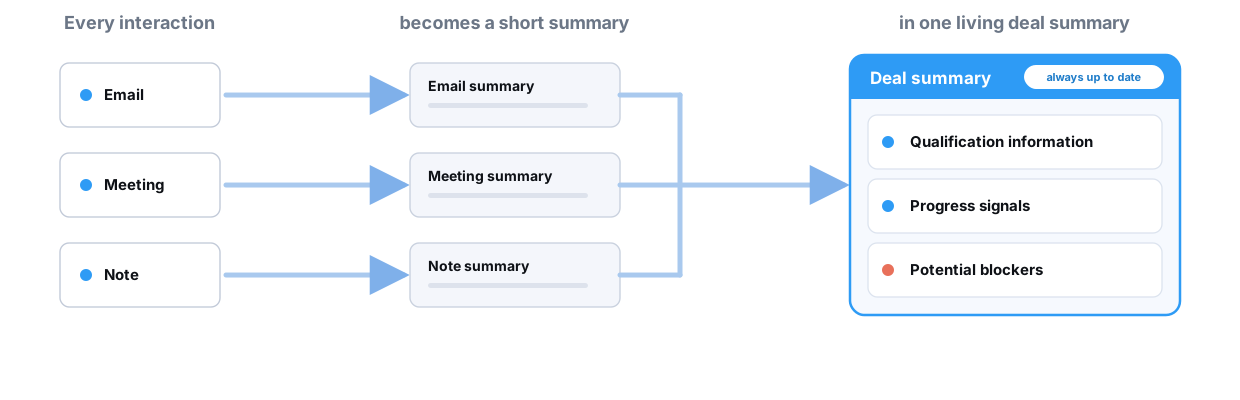
So we structure it ahead of time. We process every customer interaction the moment it happens, whether that is an email, a meeting, or a note, and we create a short, focused summary of each one. Then we pull those together into an always up to date summary of the whole deal, including the things that actually matter: qualification information, progress signals, and potential blockers.
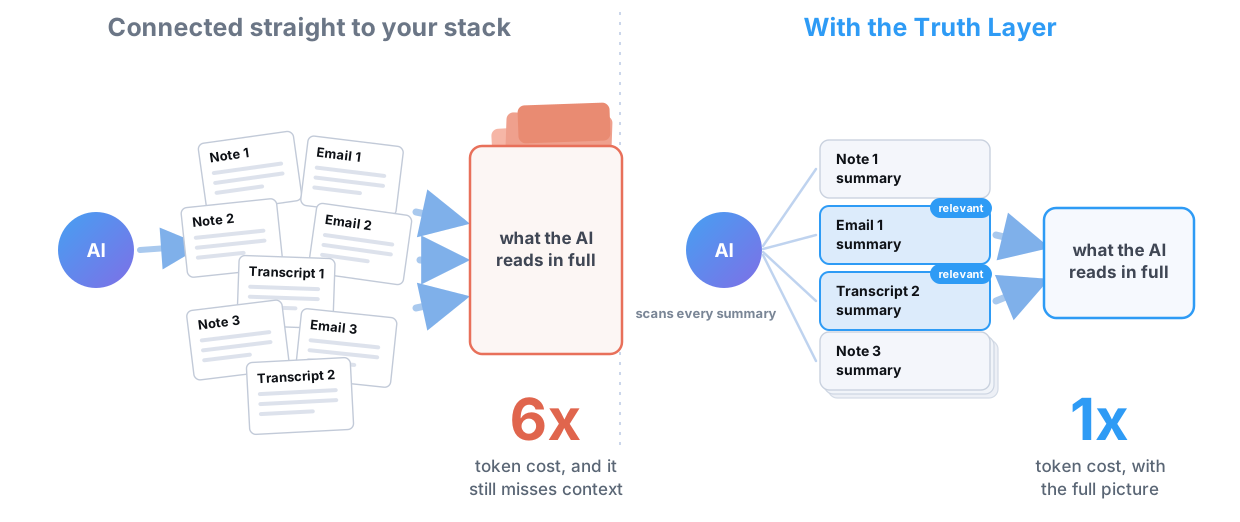
Now look at what happens to that same question. Instead of pulling entire email chains, full meeting transcripts, and every note, the AI finds the right deal from the deal summary, scans the interaction summaries to identify the few that are relevant, and pulls only those in full. The net result is that it has the complete view of the deal and every detail it needs, without dragging in everything else. Less cost, less noise, better answer.
The harder question gets easier too. For "how have we handled this objection in other similar deals," the AI can read across deal summaries to see which deals were genuinely similar and ran into the same objection, jump straight to the interaction where that objection came up, pull the full content of just that moment, and answer with confidence.
What we measured
We had customers test this directly. They started by connecting their CRM, email, and meeting recorder, in this case Gong, straight to their AI, and asked a question about a deal.
Two things stood out. First, it was rarely a one shot answer. The AI would inevitably miss information as its context window filled up, so getting to a good answer took several attempts. Second, and this is the number that matters, that same exercise cost on average six times more in tokens than when the customer ran it with Optivian connected through our MCP. And remember, that six times is just the first chat. The next time the rep asks a different question about the same deal, the whole expensive process repeats. With pre-processing in place, the heavy lifting was already done.
| Metric | Without Optivian | With Optivian | Ratio |
|---|---|---|---|
| Inference calls | 30 | 11 | 2.7× |
| Fixed overhead per call (Claude tokens) | 10,120 | 6,900 | 1.5× |
| Raw payloads carried (transcript, CRM, web, fetch) | 12,765 | 2,875 | 4.4× |
| Cumulative input tokens | 919,678 | 153,930 | 6.0× |
| Cumulative output tokens | 13,616 | 4,761 | 2.9× |
| Total billable tokens | 933,294 | 158,691 | 5.9× |
| Cost component | Without Optivian | With Optivian | Savings |
|---|---|---|---|
| Input cost | $2.76 | $0.46 | $2.30 |
| Output cost | $0.20 | $0.07 | $0.13 |
| Total cost per run | $2.96 | $0.53 | $2.43 |
Representative figures from a single customer run using Claude Cowork, connecting CRM, email, and meeting recorder (Gong) straight to the AI versus the same question answered through the Optivian MCP.
That same exercise cost on average six times more in tokens. And that is just the first chat.
The payoff of doing the work once
When you process customer interactions up front instead of reconstructing them on demand, four things change at once.
- The AI stops missing deal context, because the relevant interactions are easy to find rather than buried in raw volume.
- You can ask more complex questions across a much larger set of deals, because the AI can reason over structured summaries instead of drowning in transcripts.
- You save on average six times the token cost, because the model is no longer paying to rebuild the same picture again and again.
- You get a living view of your entire pipeline that any AI can work against, for whatever analysis you want to run.
This is what we call the Truth Layer. It is the structured, always current understanding of every deal in your pipeline, built continuously from every interaction as it happens.
Where Ollie comes in
The Truth Layer is useful on its own. You can point your AI of choice at it and get faster, cheaper, more reliable answers about any deal. But it is also Ollie's brain. It is what lets our AI co-worker move beyond answering questions on demand and start proactively taking action on deals, working alongside your reps with a full and current understanding of where every deal really stands.
The frontier models keep getting better, and that is genuinely exciting. But pointing a more powerful model at unstructured data just makes the same expensive mistakes. The teams that win are the ones who do the work of understanding their deals once, keep it current, and let every question they ask build on it.
The model you use will keep changing. What lasts is the understanding you build underneath it.
Get that right, and every question gets cheaper, sharper, and faster from there.
Ready to see Ollie in action?
Book a demo to see how Ollie executes the work that wins deals.
Book a demo