Everyone uses the same models. The difference is what they know.
The model was never the moat, everyone runs the same frontier AI. What actually separates teams is what their system knows about their deals, and whether it still knows it tomorrow.

"Can we build this? Because we already have all the brains behind it." A buyer asked me this a few weeks ago. They already run Claude and Gemini across the company. They’re a smart team with technical leadership and strong AI literacy. Their question was simple and fair.
I get some version of that in nearly every discussion I get into. It is the single most common pushback I hear: "we can do this ourselves, we already have the AI."
So let me agree with the premise before I disagree with the conclusion.
They are right that the model is not the moat. I use Claude, ChatGPT and Gemini every day, and they are fantastic tools, but everyone uses at least one of them. Some companies trained their own specialized models, but even that edge is fading. A recent Nature Medicine study from NYU Langone found general frontier models outperformed purpose-built medical AI across the board. Fundamentally, every application layer AI company does the same thing: they resell tokens and optimize context.
Optimizing context is where the real work lives. And "we'll do it ourselves" turns out to mean two very different things, with two very different answers.
The first version: "We'll just connect Claude to our CRM and prompt it."
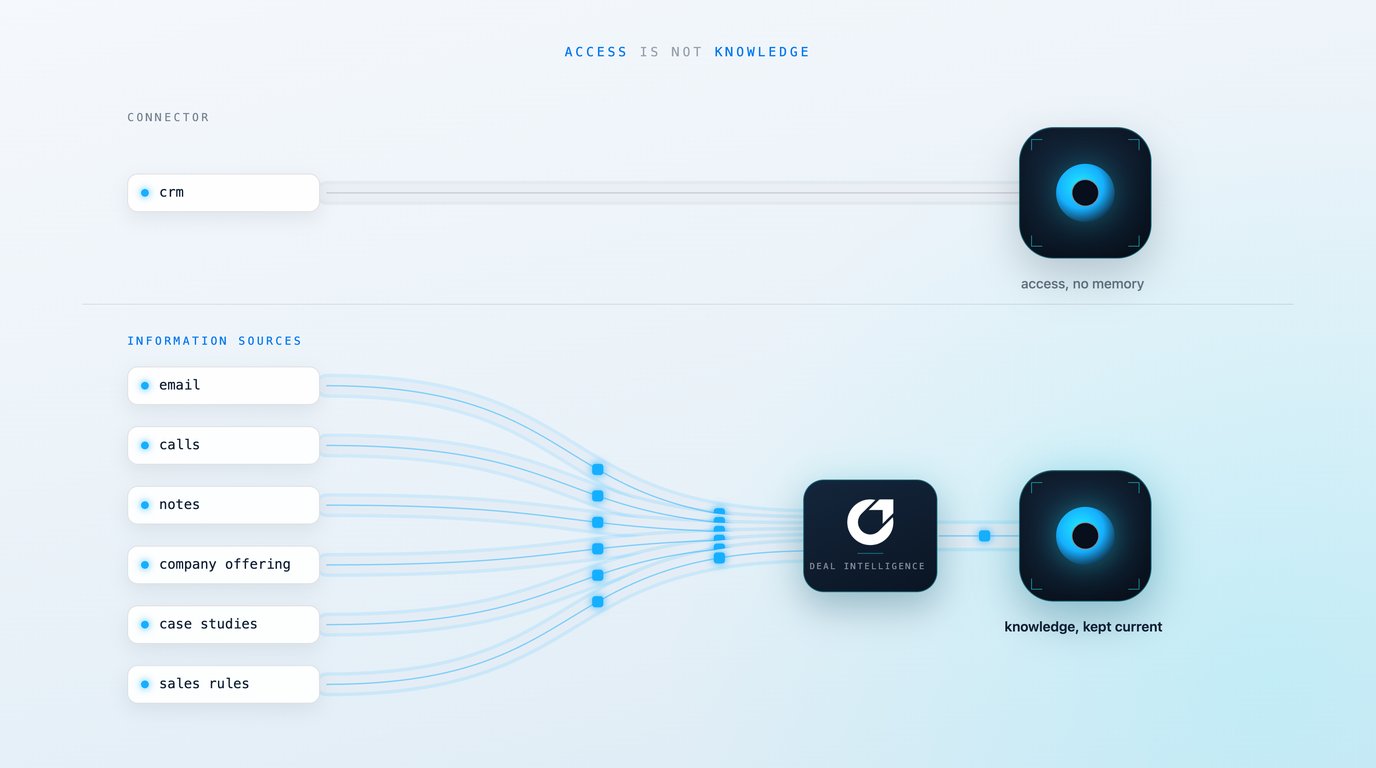
This is the tempting one, because it feels easy. You already pay for the AI, you add a connector and ask it about your pipeline. It fetches data on demand but does not curate it, structure it, or keep it. So it does not pull every interaction on a deal unless you tell it to, and the moment you stop hand-feeding context, the answer goes stale.
It also hits a ceiling. If you ask it to analyze a stage of your pipeline, it starts running tens of tool calls, and it will run out of room before it can make sense of any of them. So you break the question into smaller ones, and now you have an answer about part of the deal instead of the whole one. Furthermore, every run starts from zero. Nothing you taught it last week is there this week. This is not a system that learns your deals. Instead you have a brilliant analyst with no memory.
People who live in these tools say the same thing. One CRO who uses Claude daily put it plainly: "sometimes it actually has super outdated data, that's not correct." That is what happens when a powerful model runs on stagnant knowledge, with nothing feeding it fresh, structured context. You cannot one-shot this. This is not because the model is weak, but because nobody built the pipes that keep context flowing to it at the right moment.
A connector only gives the model access, not knowledge.
Then there are the token costs. Running all of this on Claude adds up faster than teams expect. The teams I’ve spoken with report $150 to $200 per rep per month. We have seen teams cut that spend 5 to 6x with Optivian.
The second version: "Fine, then we'll build the whole thing ourselves."
This is the serious one, and it is a different question entirely. Now you are not buying a tool, you are starting an engineering project: ingesting every email, call, and note tied to a deal, resolving who is who across all of it, structuring it, keeping it current, and surfacing the right piece of information the moment someone asks. That is not a prompt, it is a full-time job, for several people.
And it is not your edge. Your edge is your product and how you sell it. The context layer underneath is not. The leadership instinct is understandable. As one buyer told me, "the guidance from some of the others in the company would probably always be like, why can't we do this ourselves?" You can. The real question is whether maintaining a context pipeline is the best use of your best people, or whether they should be doing the work that actually sets you apart.
The most convincing answer does not come from me. It comes from the teams who tried to build it themselves first.
The buyer I opened with, the one with all the brains in-house, went and looked at what we had built. The verdict was not "this is clever" or "nice features." It was: "it's exactly what we have not been able to accomplish with the general AI tools, even though we have them."
It’s exactly what we have not been able to accomplish with the general AI tools, even though we have them.
That is the whole argument. They had the models, the talent, and deep knowledge of their own situation, and it still was not enough. What they could not solve was getting the right information out of the model at the right moment.
The models are commoditized. That is exactly why they are only part of the answer. What matters more is what your system knows, and whether it still knows it tomorrow. That is what we built: the same models everyone has, staying current on your deals on their own.
References
1. "General-purpose large language models outperform specialized clinical AI tools on medical benchmarks," Nature Medicine (June 12, 2026).
Ready to see Ollie in action?
Book a demo to see how Ollie executes the work that wins deals.
Book a demo